Talk about drugs without losing trust
Calm, practical scripts and safety plans for parents and caregivers. It has been designed to keep communication open and reduce risk. Built with parents, carers, youth workers and lived experience.
Quick start
Three practical steps you can take this week to make future conversations easier.
Keep it age‑appropriate and build it up over time. If they can hear it online or at school, they can hear it safely from you first.
Avoid “how‑to” detail. Ask what they already know, set clear boundaries, and repeat the message: “I’m here to keep you safe.”
A code word/emoji, meeting points, transport home, and a “get help early” rule reduces panic and increases honest help‑seeking.
Common questions parents ask
Five key questions that come up most often — designed to keep conversations calm, practical, and safety‑first.
- Decide your approach in advance.
- Keep it brief and purpose‑led if you share anything.
- Bring it back to them: “What made you ask?”
- Teach simple scripts: “No thanks,” “Not tonight,” “I’m driving,” “I’ve got training tomorrow.”
- Give them an ‘out’ they can blame on you: “My parents will pick me up—no questions.”
- Agree a code word/emoji for “Get me now.”
- Stay neutral: “It can feel like that, but not everyone does.”
- Ask where it’s coming from (friends, social media, school).
- Focus on their values and safety, not arguing statistics.
- Treat it as a safety and health conversation, not a moral one.
- Talk impacts they’ll recognise: sleep, anxiety, focus, motivation, money.
- Ask calmly if it’s around them and if they’ve been offered it.
- Safety first: stay calm, don’t storm in.
- Choose a planned time to talk; aim for consequences that reduce risk.
- If you suspect coercion/dealing/serious risk, get professional advice quickly.
Practical scripts you can actually use
Keep it short. Keep it calm. Keep it safety‑focused.
Opening line (when you’re worried)
“I’m not here to judge you. I’m worried about your safety. Can we talk for five minutes?”
If they shut down
“We don’t have to do this now. I’m here when you’re ready. I care about your safety, not getting you in trouble.”
No‑questions pickup plan
Agree a code word or emoji. If they send it, you collect them — no lecture in the moment. Debrief later when everyone is safe.
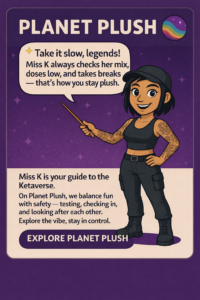
Ask Miss K
Miss K is our chatbot guide. Use it to get plain‑English, safety‑focused advice and conversation starters — any time, without judgement.
- How to start the conversation (without sounding like a cop).
- What to say if they admit they’ve tried something.
- Festival / party safety plans and “pickup” code words.
- Explaining risks in a calm, factual way.
If they’re going to a festival, rave, or big party
A simple agreement reduces panic and increases the chance of early help.
- Stay with friends (no solo missions).
- Set meeting points (and a backup point).
- Charged phone + portable charger.
- Transport home planned before they leave.
- Know where welfare/medics are (on arrival).
- Make early help‑seeking non‑negotiable.
- If anything’s taken, honesty helps medics act faster.
- Mixing substances and alcohol increases unpredictability and risk.
- “If something goes wrong, tell an adult/medic exactly what happened.”
When to involve school, a GP, or specialist support
You don’t have to wait for a crisis to get advice.
- If use is ongoing, mental health is deteriorating, or risk is escalating.
- If you suspect coercion, exploitation, or unsafe environments.
- If there has been a medical incident — professional support is appropriate.
- If you’re consistently uneasy, it’s valid to seek advice early.
Emergency danger signs
If you’re unsure, get help early rather than waiting.
If your child calls because a friend is unwell: tell them don’t leave the person alone, get staff/medics immediately, and seek urgent medical help if symptoms are severe.