HARM REDUCTION

Straight-up facts. Practical advice. No judgement.

The safest form of harm reduction is not using drugs in the first place. If you do choose to use, do it with knowledge, pacing, and people you trust.

At RaveSafe, we’re committed to up-to-date, evidence-based harm reduction guidance, because the recreational drug landscape moves fast, and strength and purity can be unpredictable.

Miss K
Miss K
Part-time mentor. Full-time raver.

Hey, I’m Miss K — and I’m fully committed to keeping you safe while you live your best life. I’ve walked every corner of the Ketaverse, danced under every planet’s glow, and seen what happens when people get caught out or don’t know what to expect from what they’re taking.

I’m not here to tell you what to do. I’m here to make sure that whatever choices you or your friends make, you understand the risks and know how to look after each other.

Important: This page is educational and not a substitute for medical care. If someone is in danger, unconscious, having a seizure, or not breathing normally: call 999 immediately. Tell medics what was taken (and roughly when) — it helps them treat the person faster and safer.
Miss K

Miss K’s top harm reduction tips

Little choices change the whole night — especially now, when strength can be way higher than you’re expecting.

Start low, go slow

Think of it like warming up for the drop. Take a small amount, then give it time to land before you even think about topping up.

Test your substances

If you can test, test. It’s the quickest way to dodge nasty surprises, weird cuts, and mis-sold pills/powders.

Hydrate (but don’t overdo it)

Sip, don’t chug. If you’re sweating buckets, add electrolytes. Too much water too fast can mess you up just as badly as dehydration.

Know the warning signs

Overheating, chest pain, extreme agitation, confusion, repeated vomiting, blue lips, or being hard to wake = get help early. Don’t “wait and see”.

Avoid mixing substances

Mixing (including alcohol) turns a predictable vibe into a roulette wheel. Stacking depressants with depressants is where things can go quiet fast.

Use safer environments

Stick with people you trust, set a meet point, and check in. If someone looks off, pull in welfare/medics early — looking after each other is the culture.

Let’s Be Real. Honesty Saves Lives

If something goes wrong at a festival or on a night out, silence is what turns a bad moment into a disaster.
Miss K

What the law usually cares about

  • Being unwell isn’t the crime: needing help is a medical issue. The immediate priority is safety and treatment.
  • Possession: having drugs on you is where legal trouble commonly starts.
  • Supply / sharing: giving, selling, or “sorting a mate” can be treated as supply — even if no money changes hands.
  • Drug driving: driving (or being in charge of a vehicle) while impaired or over limits can get you arrested and banned.
  • Other offences still apply: disorder, assault, carrying weapons, or endangering others are separate issues.
Quick reality check: if you go for help, staff are there to treat the emergency. But if someone is still carrying drugs, that can create risk — so keep it simple: get help early, and keep the focus on safety.

Why honesty gives your mate the best chance

If someone’s in trouble, friends who know what was taken are the difference between “we can treat this” and “we’re guessing”. Medics and welfare teams aren’t there to judge — they’re there to keep breathing, temperature, and heart safe.

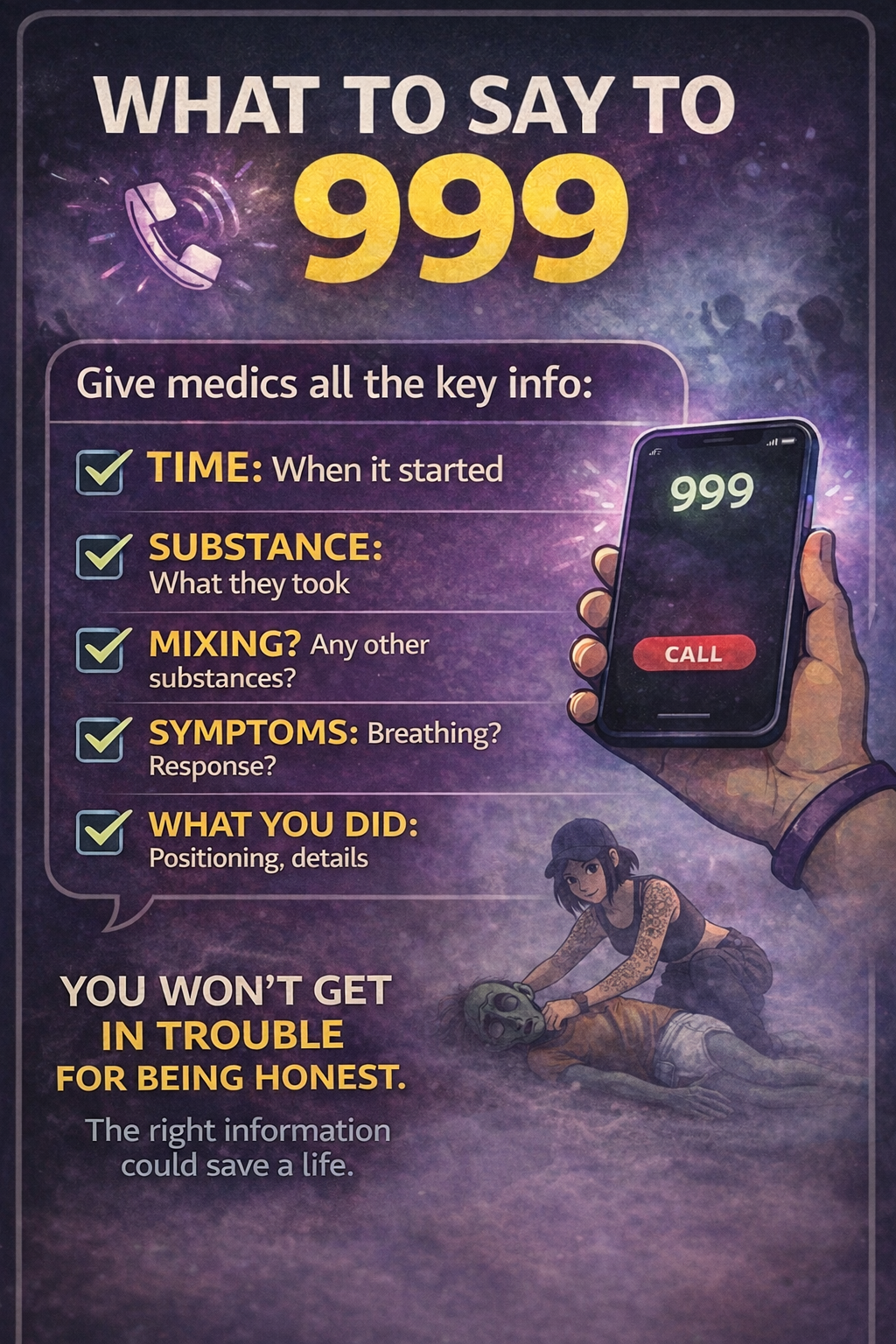
Tell staff what you know
  • What was taken (or what you think it was)
  • When and roughly how much
  • Anything mixed (alcohol / other substances / meds)
  • What’s changed (overheating, confusion, seizures, chest pain, collapse, not waking up)
If someone is unresponsive, having a seizure, or not breathing normally: call 999 straight away. Tell them what was taken (and roughly when) — it helps them treat the person faster and safer.

Educational information only. This section is provided for general education and harm-reduction awareness and is not a substitute for professional medical advice, diagnosis, or treatment, nor for legal advice. Laws and local policies can vary, and real-world situations depend on the facts. If you think someone is in immediate danger, is unconscious, having a seizure, or not breathing normally, call 999 immediately and follow the operator’s instructions.
Pick a substance and get the facts.

Search a substance below or tap a dropdown for straight-up info, key risks, and how to look after each other.

Alcohol depressant • dehydration • mixing risk

Alcohol is a legal depressant that slows your brain and body. In rave settings it’s one of the biggest risk-multipliers because it masks how impaired you are, dehydrates you, and makes mixing with other substances far more dangerous.

Key points
  • What it is: a central nervous system depressant (slower reactions, coordination, breathing).
  • How it’s used: drinks/shots. Strength varies massively (spirits, cocktails, high-ABV cans).
  • Onset & duration: can hit within 10–30 minutes and keep climbing for hours — especially if you keep topping up.
Risks
  • Alcohol poisoning: vomiting, confusion, seizures, pale/blue skin, slow/irregular breathing, unconsciousness.
  • Heat + dehydration: increases overheating risk in clubs/festivals.
  • Injuries: falls, accidents, risky decisions.
Big warning: alcohol + benzos/opioids/ketamine can suppress breathing. Don’t “let them sleep it off” — get help.
Most common festival mixes to avoid
  • Alcohol + benzos: high blackout risk and dangerously slowed breathing.
  • Alcohol + opioids: a leading overdose combination (breathing suppression).
  • Alcohol + ketamine: passing out/choking risk and breathing suppression.
  • Alcohol + cocaine/speed: can mask how unwell you are while increasing heart strain.
Safer choices
  • Eat before and pace your drinks (one drink, then a break).
  • Alternate with soft drink/water — sip, don’t chug.
  • Set a limit early (and stick to it when the music kicks off).
  • If someone is hard to wake, breathing oddly, or keeps vomiting: call 999.

Miss K summary: alcohol is the sneaky one. It’s everywhere, it feels normal — but it’s a heavyweight when it comes to accidents, overheating, and dangerous mixes.

Ketamine dissociative • falls • k-hole

Ketamine is a dissociative anaesthetic that can create a detached, dream-like state. It’s common in club and festival settings for its floaty effects — but it can also shut down coordination and awareness fast.

Key points
  • What it is: a dissociative (mind/body separation). Also called K, ket, wonk, special K.
  • Appearance: usually white powder or clear crystals.
  • How it’s used: most often snorted; sometimes swallowed (“bombed”). Injecting is high-risk.
Risks
  • Falls & injuries (people don’t feel pain / can’t coordinate).
  • Choking risk if unconscious or vomiting.
  • Bladder damage with frequent use.
  • Mixing danger: ketamine + alcohol/benzos/opioids increases passing out and breathing risk.
Miss K warning: if someone is slumped, hard to wake, or breathing oddly — don’t “let them sleep it off”. Get help.
Most common festival mixes to avoid
  • Ketamine + alcohol: passing out/choking risk and breathing suppression.
  • Ketamine + benzos/opioids: high risk of unconsciousness and slowed breathing.
  • Ketamine + nitrous: dizziness/blackouts and serious fall risk.
Safer choices
  • Start low, go slow — and sit down if you’re wobbling.
  • Keep them on their side if they’re out of it (recovery position) and get medical help.
  • Avoid mixing with depressants (alcohol/benzos/opioids).
  • Regular use can wreck your bladder — take breaks and listen to symptoms.

Summary: ketamine can feel floaty, but it can also freeze movement and judgement. Dose carefully, don’t mix, and keep people safe from falls and choking.

MDMA stimulant • overheating • serotonin

MDMA (ecstasy, molly, mandy) is a stimulant/empathogen known for energy, euphoria, and emotional connection. Strength varies wildly, and mis-sold pills/powders are a real risk.

Key points
  • Forms: tablets/pills, powder, crystals.
  • Onset: usually 30–60 minutes (oral). Effects last 3–6 hours; after-effects can last longer.
Risks
  • Overheating: especially in hot/crowded venues.
  • Hydration mistakes: dehydration and over-drinking water can both be dangerous.
  • Serotonin syndrome (medical emergency): agitation, confusion, heavy sweating, tremor, high temperature.
  • Mis-sold contents: pills may contain little/no MDMA or dangerous substitutes.
Miss K warning: mixing MDMA with SSRIs/other serotonergic drugs can increase serotonin-syndrome risk. If someone is getting hotter, more confused, or more agitated — get help early.
Most common festival mixes to avoid
  • MDMA + alcohol: dehydration/overheating risk and worse comedowns.
  • MDMA + cocaine/speed: stacked stimulants → more heart strain and overheating risk.
  • MDMA + SSRIs/MAOIs/other serotonergic drugs: higher serotonin-syndrome risk.
Safer choices
  • Test where possible. Don’t trust logos.
  • Take breaks from dancing; cool down; sip water steadily.
  • Avoid stacking stimulants and avoid mixing with alcohol.
  • If someone has chest pain, collapses, seizures, or is unresponsive: call 999.

Summary: MDMA can feel like pure love — but heat, hydration mistakes, and unknown contents are where danger creeps in. Pace it, cool down, and don’t mix.

Cocaine stimulant • heart strain • comedown

Cocaine is a powerful stimulant that can feel energising and confidence-boosting, but it’s short-acting, encourages redosing, and puts heavy strain on the heart — especially when mixed with alcohol or other stimulants.

Risks
  • Heart strain: high blood pressure, arrhythmias, heart attack or stroke risk.
  • Anxiety/paranoia and aggression.
  • Dependence: strong urge to redose due to short high.
Big warning: cocaine + alcohol produces cocaethylene in the body, increasing strain and risk.
Most common festival mixes to avoid
  • Cocaine + alcohol: increased strain and higher risk behaviour.
  • Cocaine + MDMA/speed: stacked stimulants → heart strain and overheating risk.
  • Cocaine + sedatives (benzos/opioids): can hide danger signs and increase accidental overdose risk.
Safer choices
  • Avoid mixing with alcohol and other stimulants.
  • Chest pain, severe headache, collapse, seizures = 999.

Summary: cocaine can feel sharp and social, but it’s a heart-stressor with a quick drop-off that pushes people into binges. Mixing is where it gets especially risky.

Cannabis anxiety • edibles • impairment

Cannabis can relax you and heighten senses — but strength varies, it can trigger anxiety/paranoia, and it impairs coordination and judgement (especially with alcohol).

Risks
  • Impairment: falls, accidents, unsafe decisions.
  • Mental health: can worsen anxiety; higher risk for under-25s and those prone to psychosis.
  • Edibles: slow onset and long duration — easy to overdo.
Miss K tip: if someone is panicking, get them somewhere calm, cool and quiet. Reassure them, slow breathing, and keep them safe until it passes.
Most common festival mixes to avoid
  • Cannabis + alcohol: spins, vomiting, blackouts, and accidents.
  • Cannabis + psychedelics: can intensify visuals/headspace and trigger panic.
  • Cannabis + stimulants: can increase anxiety, racing thoughts, and paranoia.
Safer choices
  • Start small, especially with edibles. Wait before taking more.
  • Avoid mixing with alcohol if you’re prone to anxiety.
  • Don’t drive or do risky stuff — you’re more impaired than you think.

Summary: cannabis can be mellow or it can bite — dose, setting, and product strength decide which one you get.

2C-B psychedelic • dose-sensitive • anxiety

2C-B is a synthetic psychedelic with a body buzz and visuals. People describe it as “between MDMA and LSD” — but dose and mindset matter, and pills can be mis-sold.

Risks
  • Anxiety, panic, paranoia — especially in chaotic settings.
  • Accidental overwhelm if a pill is stronger than expected.
  • Mixing with MDMA/alcohol/ketamine increases risk of overheating or bad trips.
Miss K warning: snorting 2C-B is notoriously painful and can hit very hard. If you’re new: swallow, go low, and be patient.
Most common festival mixes to avoid
  • 2C-B + MDMA: overstimulation, overheating, and harder comedowns.
  • 2C-B + alcohol: increased nausea, confusion, and risky decisions.
  • 2C-B + ketamine: higher confusion/dissociation and accident risk.
Safer choices
  • Start low and wait — redosing too early is where people get overwhelmed.
  • Trip with people you trust; choose calmer spaces to reset if it gets heavy.
  • Avoid mixing with other substances.

Summary: 2C-B can be colourful and euphoric — but dose turns the dial fast. Respect it, don’t mix, and protect your headspace.

Pink Cocaine (Tusi) unpredictable mix • overdose risk

“Pink cocaine” / “tusi” is usually not cocaine and often not real 2C-B either. It’s commonly a bright pink powder made from an unpredictable cocktail of substances — which is why the risk level is high.

Risks
  • Overdose risk: unknown strength + unknown ingredients.
  • Dangerous interactions: stimulants and depressants together can strain heart and breathing.
  • Harder to treat medically if nobody knows what’s in it.
Miss K warning: “designer” branding doesn’t mean safer. With tusi, the main risk is that you don’t actually know what you’ve taken.
Most common festival mixes to avoid
  • Tusi + alcohol: unpredictable effects and higher risk of passing out or overheating.
  • Tusi + stimulants: stacked heart strain (and you still don’t know what’s in the mix).
  • Tusi + depressants (benzos/opioids/ketamine): higher risk of unconsciousness and breathing problems.
Safer choices
  • If you can’t verify what it is, the safest option is not taking it.
  • Avoid mixing with anything else.
  • If someone deteriorates quickly (overheating, chest pain, collapse, confusion): 999.

Summary: pink cocaine is a misleading name for an unknown mix. Treat it as high risk — because that’s what it is.

Speed (Amphetamine) stimulant • sleep loss • anxiety

Speed is a street name for amphetamine — a stimulant that speeds up the brain and body. It can keep you going for long nights, but it’s harsh on your heart, your mood, and your sleep.

Key points
  • What it is: a stimulant that increases alertness, energy, and confidence.
  • Appearance: usually white/off-white powder or paste; often cut with caffeine or fillers.
  • Duration: can last 4–8 hours (sometimes longer), with insomnia afterwards.
Risks
  • Heart strain: fast pulse, high blood pressure, chest pain.
  • Overheating/dehydration: more likely if you’re dancing for hours.
  • Comedown: low mood, irritability, anxiety, and poor sleep.
  • Binges: short “up” pushes people into redosing and going too long without rest.
Miss K warning: if someone has chest pain, collapses, has a seizure, or can’t be woken — that’s a medical emergency. Call 999.
Most common festival mixes to avoid
  • Speed + MDMA/cocaine: stacked stimulants → higher overheating and heart risk.
  • Speed + alcohol: masks impairment while increasing dehydration and risky decisions.
  • Speed + benzos/opioids: can hide danger signs and raise overdose risk when people “balance” highs and lows.
Safer choices
  • Take regular breaks, cool down, and prioritise sleep and food when you can.
  • Avoid stacking stimulants and avoid mixing with alcohol.
  • If someone becomes very agitated, confused, or overheated — involve welfare/medics early.

Summary: speed can feel like energy on tap — but it takes payment in sleep, mood, and heart strain. Keep it simple, pace it, and don’t stack stimulants.

LSD psychedelic • long trip • set/setting

LSD (acid, tabs, Lucy) is a powerful psychedelic that can change perception, emotions, and sense of time. It lasts a long time — which is why planning, mindset, and environment matter more than bravado.

Key points
  • Forms: blotter tabs, liquid, gel tabs.
  • Onset: 30–90 minutes. Duration: commonly 8–12 hours (sometimes longer).
  • Set & setting: your mood + your environment can make or break the experience.
Risks
  • Panic/bad trips: anxiety, paranoia, confusion — especially in chaotic settings.
  • Accidents: impaired judgement and coordination.
  • Mental health: can trigger or worsen underlying conditions in vulnerable people.
Miss K tip: if someone is overwhelmed, reduce stimulation: quiet space, calm voice, slow breathing, reassurance. If they’re unsafe, unwell, or out of control: get welfare/medics.
Most common festival mixes to avoid
  • LSD + alcohol: more confusion, accidents, and risky decisions.
  • LSD + stimulants (MDMA/cocaine/speed): overstimulation, anxiety, overheating risk.
  • LSD + heavy cannabis: can intensify the headspace and trigger panic/paranoia.
Safer choices
  • Choose a safer environment and supportive people; have a calm exit plan if it gets too much.
  • Avoid mixing, especially with alcohol and stimulants.
  • If someone has chest pain, seizures, collapses, or becomes unresponsive: call 999.

Summary: LSD is long-haul. If you’re not in the right headspace or place, it can turn heavy. Set, setting, and support are everything.

DMT intense • fast onset • headspace

DMT is one of the most intense psychedelics. Smoked/vaped, it can hit in seconds and feel like you’ve stepped into another dimension. It’s not a casual party add-on — it demands a safe setting and support.

Key points
  • Forms: crystals/powder, vape liquids, or herbal blends (changa). Ayahuasca is oral DMT combined with MAOIs.
  • Duration: smoked/vaped is short (often minutes) but extremely immersive; oral preparations last much longer.
Risks
  • Overwhelm/panic: fear, confusion, distress — especially in noisy environments.
  • Safety: people can be disoriented — falls/injury risk if not supervised.
  • Medication interactions: MAOIs (including in ayahuasca/changa) can interact dangerously with many meds.
Miss K warning: DMT plus MAOI combinations (ayahuasca/changa) can be dangerous with certain medications. If you’re unsure, the safer choice is not to mix — and not to take it.
Most common festival mixes to avoid
  • DMT + alcohol: more nausea, confusion, and accidents.
  • DMT + stimulants: heightened anxiety and overstimulation.
  • DMT (with MAOIs) + serotonergic drugs (SSRIs/MDMA etc.): increased risk of serious reactions.
Safer choices
  • Keep it away from loud, crowded spaces. Calm environment and trusted support matter.
  • Avoid mixing with other substances and be cautious around medications.
  • If someone is distressed, unsafe, or becomes unresponsive: get medics and call 999.

Summary: DMT is short but enormous. Treat it with respect, keep the environment safe, and don’t stack it with other substances.

Psilocybin (Mushrooms) psychedelic • nausea • headspace

Psilocybin (magic mushrooms) can bring visuals, emotional waves, and deep introspection. It can also bring nausea and overwhelm, especially if the setting is chaotic or you’re already anxious.

Key points
  • Onset: often 20–60 minutes. Duration: commonly 4–6 hours.
  • Variability: strength can vary by type and preparation — effects are not predictable.
Risks
  • Bad trips: panic, paranoia, feeling trapped in thoughts.
  • Nausea/vomiting can happen — keep people safe from choking if they’re very out of it.
  • Mental health: higher risk for those with personal/family history of psychosis.
Miss K tip: if someone is spiralling, lower stimulation and anchor them: calm voice, remind them it will pass, keep them hydrated in sips, and stay with them.
Most common festival mixes to avoid
  • Mushrooms + alcohol: more nausea, confusion, and accidents.
  • Mushrooms + cannabis: can intensify the trip and trigger panic/paranoia.
  • Mushrooms + stimulants: overstimulation and anxiety risk.
Safer choices
  • Choose calmer spaces and supportive friends; crowded chaos is not your friend here.
  • Avoid mixing, especially with alcohol and heavy cannabis.
  • If someone is unsafe, unresponsive, or having seizures: call 999.

Summary: mushrooms can be beautiful — or intense. Protect the setting, protect the headspace, and don’t stack substances.

Benzodiazepines (Benzos) sedative • blackouts • overdose risk

Benzos are prescription sedatives (e.g., diazepam/Valium, alprazolam/Xanax) used for anxiety and sleep. Recreational use is high-risk: blackouts, dangerous decisions, and deadly interactions — especially with alcohol or opioids.

Key risks
  • Breathing suppression when mixed with other depressants.
  • Blackouts: people can look “awake” but later remember nothing.
  • Fake pills: street benzos can be unpredictable and may contain other dangerous substances.
  • Dependence: withdrawal can be severe and include seizures.
Miss K warning: if someone is very drowsy, can’t stay awake, has slow/odd breathing, blue lips, or won’t wake up — call 999. Do not leave them alone.
Most common festival mixes to avoid
  • Benzos + alcohol: extreme blackout risk and dangerously slowed breathing.
  • Benzos + opioids: one of the highest-risk overdose combinations.
  • Benzos + ketamine: unconsciousness/choking risk and breathing suppression.
Safer choices
  • Avoid mixing with alcohol or other depressants — this is where deaths happen.
  • If someone has taken benzos and is vomiting or drifting in/out: keep them on their side and get help.
  • Don’t share pills and don’t assume you know what’s in them.

Summary: benzos don’t look dramatic — they look sleepy. That’s the danger. Mixing is a red-alert zone.

Heroin (Opioids) overdose • breathing • naloxone

Heroin is an opioid depressant that slows breathing and can cause deep sedation. With today’s unpredictable street supply, overdose risk is extremely high — especially when mixed with alcohol or benzos.

Overdose signs (act fast)
  • Slow, shallow, or stopped breathing
  • Blue/grey lips or fingertips
  • Cold, clammy skin
  • Unconscious and can’t be woken
Miss K warning: if you see overdose signs, call 999 immediately. Tell them you suspect an opioid overdose. If naloxone is available, use it and keep monitoring breathing until help arrives.
Most common festival mixes to avoid
  • Opioids + benzos: high risk of fatal breathing suppression.
  • Opioids + alcohol: dangerous sedation and overdose risk.
  • Opioids + ketamine: increased unconsciousness and breathing risk.
Safer choices
  • Never use alone — get someone sober to keep watch and call for help if needed.
  • Avoid mixing with any other depressants.
  • If you’re in the UK and can access it, carry naloxone and know where it is.

Summary: opioids are a breathing risk first and foremost. If you’re unsure, treat it as an emergency and get help early — seconds matter.

Nitrous Oxide (NOS) hypoxia • falls • b12 risk

Nitrous (NOS, balloons) is a short-acting dissociative gas. It can feel funny and floaty, but the risk comes from oxygen deprivation, sudden dizziness, and repeated use.

Risks
  • Hypoxia: oxygen deprivation can cause blackouts and injury.
  • Falls: sudden wobbles or collapse are common.
  • Frost burns: inhaling directly from a canister can freeze tissue.
  • B12 depletion: heavy/repeated use can contribute to nerve damage (tingling, numbness, weakness).
Miss K warning: never inhale directly from a canister. Use sitting down, and if someone passes out or is injured — get help.
Most common festival mixes to avoid
  • Nitrous + ketamine: dizziness/blackouts and serious fall risk.
  • Nitrous + alcohol/benzos: more passing out and breathing risk.
  • Nitrous + other drugs: mixing increases unpredictability when you’re already oxygen-deprived.
Safer choices
  • Use sitting down and take long breaks between balloons.
  • Stop if you feel tingling/numbness — that’s a red flag for heavy use.
  • If someone is unresponsive or not breathing normally: call 999.

Summary: NOS is short, but the harm can be long. Oxygen deprivation and falls are the main dangers — keep it seated, spaced out, and unmixed.

SUPPORT

Trusted Support & Harm Reduction Services

If you need help, advice, or reliable alerts, these organisations are solid. If someone is in immediate danger, call 999.

Organisation
Focus
Contact
The Loop
Festival drug testing & public alerts
WEDINOS
Anonymous drug testing & substance alerts
Release
Drug law & harm reduction advice
Turning Point
Drug & alcohol support services
Change Grow Live (CGL)
Nationwide addiction recovery support
Crew 2000
Scottish drug info, harm reduction & drop‑ins
We Are With You
Mental health & substance use recovery
Release – Human Rights Project
Drugs & human rights advocacy
Humankind
Health, housing & drug recovery charity
Transform Drug Policy Foundation
Evidence‑based drug policy reform & education

Educational info only — not legal or medical advice. If you’re worried about someone’s breathing, consciousness, seizures, or overheating, get help immediately and call 999.

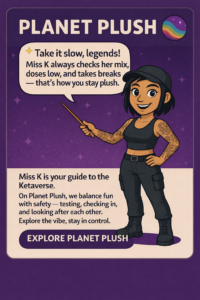
Planet Plush The World Of Miss K

Planet Plush isn’t about extremes — it’s about finding balance in a chaotic universe.
Miss K knows that life can be intense, numbing, or overwhelming — but softness, stillness, and self-awareness bring you back to centre.

Whether you’re floating through the stars or feeling stuck in shadow, pause, breathe, and check in.
Use with intention, not escape. Rest when you need to. Speak kindly to yourself.

You don’t need to feel everything — or nothing — all at once.
Planet Plush teaches that healing lives in the in-between.

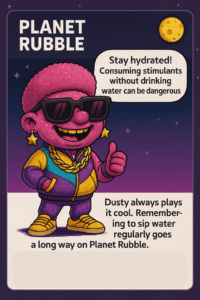
Planet Rubble - The World Of Pink Cocaine

On Planet Rubble, nothing’s quite what it seems.
“Pink cocaine” might look cute — but it’s often a chaotic mix of unknown chemicals, and no two batches are the same.

Some blends contain 2C-B, others include MDMA, ketamine, or speed — and some have no psychedelic at all.
The effects range from euphoric to unpredictable to downright dangerous.

Start tiny, test if you can, and don’t mix it with anything else.
It hits harder than it looks — especially when snorted.
Avoid redosing until you really know how your body reacts.

Planet Rubble is unstable terrain — tread lightly.

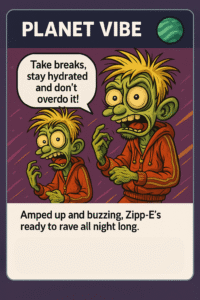
Planet Vibe - The World Of Speed

Speed keeps you going — but on Planet Vibe, too much can burn you out fast. You might feel focused, energised, or chatty, but that high can quickly tip into anxiety, tension, or paranoia.

Lack of sleep, not eating, and redosing too often can wreck both body and mind.
Overheating and heart strain are real risks — especially when dancing for hours.

Eat well, sip water, and take breaks.
Avoid mixing with alcohol or other uppers, and don’t use for days on end.
Rest and recovery matter more than you think.

Planet Vibe runs on rhythm — not overdrive.

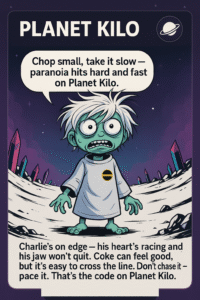
Planet kE - The World Of Cocaine

Cocaine can make you feel confident, chatty, and wired — but it’s also fast, intense, and risky. On Planet Kilo, your heart races, your jaw tightens, and the comedown can hit hard.

Short-lasting highs lead many to redose quickly, but that’s when paranoia, anxiety, and crashes creep in.
It’s easy to cross the line — especially in crowded or unfamiliar spaces.

Chop small. Don’t chase it. Avoid mixing with alcohol or other drugs.
Stay cool, stay calm, and know when to stop.

Planet Kilo rewards pacing, not pushing.

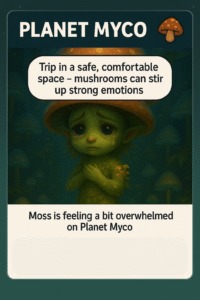
Planet Myco - The World Of Plecybin

Magic mushrooms can open the mind and shift perception — but they’re powerful and unpredictable. On Planet Myco, time can stretch, visuals can bloom, and emotions can feel intense.
Start with a low dose in a safe, comfortable setting, ideally with someone you trust.

Avoid mixing with other substances, especially alcohol.
Trips can last 4–6 hours, and while many feel joyful or insightful, some can be overwhelming.

Stay grounded. Stay hydrated. And remember — the setting shapes the journey.

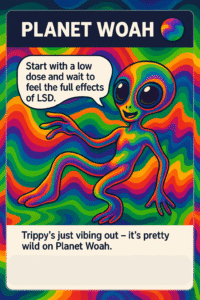
Planet Woah - The World Of LSD

LSD can take your mind on wild adventures — but Planet Woah isn’t always easy to navigate.
Visuals, thoughts, and emotions become intensely amplified, and the trip can last 8–12 hours.

Set and setting are everything.
If you’re anxious, overwhelmed, or in a chaotic place, the experience can spiral into confusion or fear.
Bad trips feel very real — even though they’ll pass.

Start low. Stay safe. Be somewhere calm with people you trust.
Avoid mirrors, crowded spaces, and mixing with other substances.

Planet Woah is powerful — respect the journey.

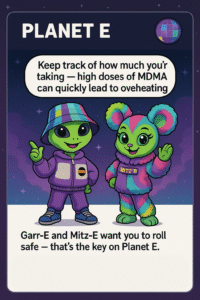
Planet E - The World Of MDMA (ecstacy)

MDMA can feel like pure connection — open hearts, glowing faces, and waves of love.
But on Planet E, what starts magical can turn risky without care.

Overheating, dehydration, and redosing are the biggest dangers.
MDMA also hits harder when mixed with alcohol, stimulants, or SSRIs — and once your serotonin is spent, chasing the high just leads to a crash.

Start low, wait at least 2 hours before redosing (if at all), and sip water slowly — no more than a pint an hour.
Take breaks, look after your mates, and know that less is often more.

Planet E shines brightest when you party with your head and your heart.

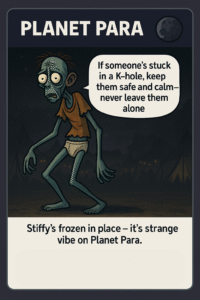
Planet PaRa - The World Of Ketamine

Ketamine creates a floaty, dream like state – but it’s not a party drug to take lightly.  can completely shut down movement and awareness the (K-hole), and regular use can wreck your bladder and mental health. Watch your dose. avoid mixing and always stay safe and grounded.

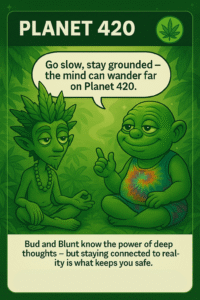
Planet 420 - The Home Of Bud & Blunt

Planet 420 moves at its own pace. Conversations run deep, snacks disappear, and time melts into laughter and thought.
Bud & Blunt aren’t in a rush — and they’ll be the first to tell you that’s the point.

Cannabis may feel mellow, but it’s not risk-free.
Too much too fast can cause anxiety, paranoia, or greening out.
Edibles hit differently — wait at least 1–2 hours before considering more.

Respect your limits, stay hydrated, and don’t mix with alcohol or other drugs.
Sometimes the deepest vibe is just being fully present.

Planet 420 isn’t about escape — it’s about connection.